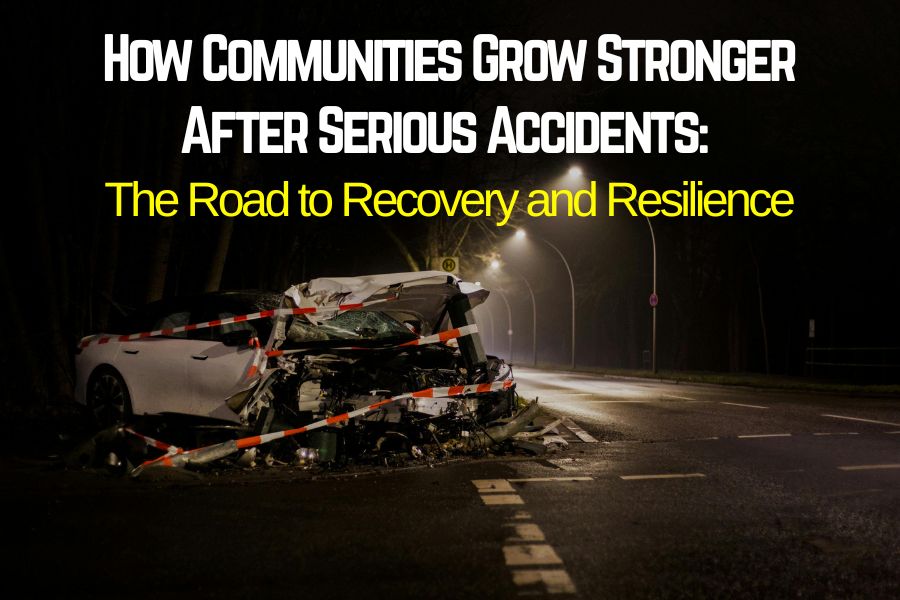
How Communities Grow Stronger After Serious Accidents: The Road to Recovery and Resilience
Serious accidents and personal injuries touch nearly every community in America.
It could be a car collision on a busy highway, a workplace incident, or a slip-and-fall in a public space. Regardless of the scenario, these events can reshape lives in an instant.
Yet, what often goes unnoticed in the immediate aftermath is a remarkable capacity to recover.
Individuals, families, and communities have the power to rebuild, advocate for change, and emerge with a deeper commitment to safety and justice.
Recovery is possible, and meaningful support systems do exist.
Understanding this is one of the most empowering messages that can be shared with anyone navigating the difficult terrain after a serious injury.
1. The Physical and Emotional Journey of Healing
Recovery from a serious injury is rarely a straight line.
Physical rehabilitation can take months or even years, and the emotional toll is often just as significant as the bodily harm.
For many survivors, dealing with chronic pain becomes an exhausting daily reality, fueling feelings of frustration, anxiety, and uncertainty about the future.
However, research and clinical experience consistently show that those who receive consistent medical care, emotional support, and clear guidance about their options tend to recover more fully and more quickly than those who try to navigate the process alone.
Connecting with the right healthcare providers early is essential.
Physical therapists, occupational therapists, and mental health counsellors all play vital roles in comprehensive recovery.
Many hospitals and rehabilitation centres now offer integrated care teams precisely because the medical community recognises that healing the whole person, not just the injured body part, produces the best long-term outcomes.
Communities that invest in these resources see measurable improvements in quality of life for injury survivors.
2. Understanding Your Legal Rights as an Injury Survivor

One of the most empowering steps an injury survivor can take is to understand their legal rights.
Many people are unaware that they may be entitled to compensation for medical expenses, lost wages, and pain and suffering, particularly when their injury was caused by someone else’s negligence.
This knowledge does not just benefit the individual; it creates accountability within communities and incentivises safer practices among businesses, drivers, and property owners.
Seeking guidance from a qualified personal injury lawyer can make a profound difference in how effectively a survivor is able to rebuild their life.
Legal professionals who specialise in this area understand the complexities of insurance negotiations and liability assessments.
They also understand the documentation required to build a strong case.
More importantly, they serve as advocates for people.
These are individuals who might otherwise feel overwhelmed and powerless during one of the most difficult periods of their lives.
Access to quality legal representation levels the playing field.
And it ensures that injured individuals are not simply left to absorb the financial consequences of someone else’s negligence.
3. How Advocacy Drives Safer Communities

Every personal injury case that results in accountability has a ripple effect beyond the courtroom.
When businesses are held responsible for unsafe conditions, they invest in better safety protocols.
If drivers face consequences for reckless behaviour, the message about responsible driving spreads.
When property owners understand that negligence has legal consequences, they maintain their spaces more carefully.
In this way, the pursuit of justice after an injury is not merely a personal matter; it is a community-wide force for positive change.
Advocacy organisations, community groups, and legal professionals often work together to push for policy improvements as well.
Local coalitions have successfully lobbied for better crosswalk lighting, improved workplace safety regulations, and stricter enforcement of traffic laws.
These efforts rarely make headlines, but they prevent future injuries and save lives.
Survivors who channel their experiences into advocacy frequently report a renewed sense of purpose and connection to their communities.
4. The Role of Public Health in Injury Prevention
Injury prevention is a public health priority that receives increasing attention from researchers, policymakers, and healthcare professionals.
According to the Centres for Disease Control and Prevention, unintentional injuries are among the leading causes of death and disability in the United States, making prevention and recovery support critical areas of public investment.
When communities prioritise injury prevention through education, infrastructure improvements, and robust emergency response systems, the overall burden of injury decreases significantly.
Schools, workplaces, and local governments all have roles to play. Safety education programs in schools teach children about road safety and fall prevention.
Workplace safety training reduces occupational hazards.
Municipal investments in well-maintained roads, accessible sidewalks, and clear signage create environments where the risk of accidents is meaningfully reduced.
These proactive measures reflect a community’s commitment to protecting its members before harm occurs, rather than simply responding after the fact.
5. Building a Support Network That Lasts

One of the most powerful factors in a positive recovery outcome is the presence of a strong support network.
Friends, family members, neighbours, and colleagues all contribute to an injured person’s ability to cope, adapt, and move forward.
Communities that cultivate cultures of mutual support, where people check in on one another and rally around those who are struggling, consistently demonstrate better collective resilience in the face of adversity.
Support groups specifically for injury survivors have grown considerably in recent years, both in-person and online.
These groups offer something that medical care and legal representation cannot fully provide: the lived experience of others who truly understand the journey.
Hearing from someone who has navigated similar challenges and found a way to rebuild can be transformative.
It normalises the struggle, reduces isolation, and provides practical insights that no textbook or brochure can replicate.
Within these supportive networks, a survivor might finally find the real-world answers to unique professional struggles, such as uncovering a vital guide like “Injured and Self-Employed? Here are 4 Things No One Tells You” to help protect their business and livelihood.
6. Financial support systems also matter enormously.

Nonprofit organisations, community foundations, and government assistance programs can help bridge the gap during the period when an injured person is unable to work.
Understanding what resources are available, and having advocates who can help access them, makes a tangible difference in both the pace and quality of recovery.
Recovery from a serious injury is a journey that no one should have to take alone.
The path forward is shaped by the quality of support available at every stage.
This journey spans from the first steps of medical treatment to the longer process of rebuilding financial stability and emotional well-being.
Communities must invest in healthcare access, legal advocacy, safety infrastructure, and genuine human connection.
In doing so, they create environments where even the most difficult setbacks can become the foundation for remarkable resilience.
Many individuals have walked this road and emerged stronger.
Their stories are a testament to what becomes possible when the right resources, the right advocates, and the right community are all working together.
Check out: Top 5 Legal Strategies For Successful Personal Injury Claims
Final Note
Serious accidents shake communities, but they also reveal incredible strength.
True recovery is never a solo journey.
It requires a dedicated network of medical care, legal advocacy, and mutual support.
By pursuing justice, survivors hold negligent parties accountable and drive vital safety improvements.
Ultimately, resilience is a community-wide effort.
Together, we can turn personal setbacks into a safer, stronger future for everyone.