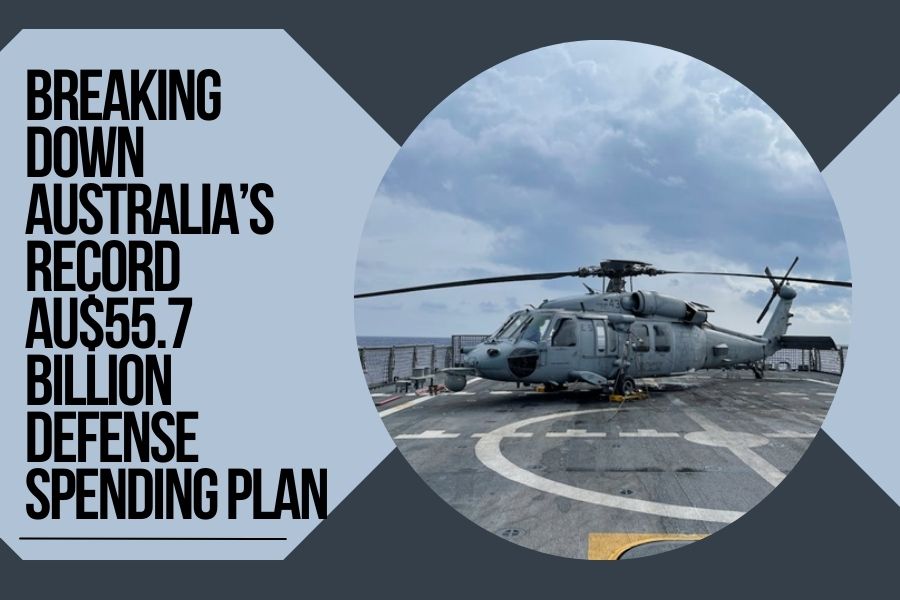
Australia’s AU$55.7 billion defense plan for 2025 signals a bold shift in its national security strategy.
With rising geopolitical tensions in the Indo-Pacific, this unprecedented investment highlights the country’s growing focus on strengthening its military capabilities.
The latest defence plan also sets Australia on a long-term path to achieve AU$100 billion in defence spending by 2033-2034.
This considerable increase reflects a response to immediate threats and a commitment to maintaining security in an increasingly complex global environment.
The Australia’s AU$55.7 billion defense plan is just the beginning.
Government projections show that defence expenditures will surge to AU$67.4 billion by 2027-2028, with a clear roadmap toward securing the nation’s future.
This strategy’s heart lies in a comprehensive focus on upgrading equipment, enhancing military capabilities, and investing in future-proof technologies.
1. Significant Defense Allocations: Navy Takes the Lead
Australia’s Navy receives the lion’s share of the budget, with AU$10.7 billion allocated for fleet expansion and upgrades.
Nuclear-powered submarines stand out as a key focus, with spending in this area set to rise dramatically from AU$ 475 million last year to AU$2.8 billion in the next fiscal year.
These investments form part of the AUKUS agreement, a trilateral security pact between Australia, the United States, and the United Kingdom.
This alliance bolsters Australia’s defence capabilities through advanced technology and military cooperation.
Six Hunter-class frigates will receive AU$813 million as part of this significant naval investment.
Additionally, six Arafura-class offshore patrol vessels are allocated AU$ 587 million.
These ships will protect Australia’s maritime interests in increasingly contested waters.
Defence project consultants will play a crucial role in overseeing the complex procurement and integration processes.
They will use their expertise to ensure timely delivery of these advanced vessels, aligning with the strategic requirements outlined in the national defence plan.
However, the lack of budget allocations for new general-purpose frigates, anticipated for selection next year, raises questions about future naval priorities.
2. Army’s Modernisation and Key Acquisitions
Australia’s Army is also receiving a substantial boost, with AU$11.8 billion allocated for modernising its land forces.
This funding will procure cutting-edge assets, including Boxer armoured vehicles, Redback infantry fighting vehicles, and Huntsman self-propelled howitzers.
Advanced artillery systems, such as the High Mobility Artillery Rocket System (HIMARS) and the acquisition of M1A2 Abrams tanks, are also key priorities.
These systems will ensure Australia’s ground forces remain agile, resilient, and ready for future conflict.
Helicopter fleets are also upgrading, with new UH-60M Black Hawks and AH-64E Apache helicopters coming into service.
These assets will provide Australia’s land forces with enhanced mobility and firepower, making them better equipped to respond to evolving threats.
While these investments significantly enhance military capability, there are challenges.
Australia’s defence budget faces pressure from rising personnel costs and delayed recruitment efforts.
In fact, the Army and other branches of the military face a recruitment shortfall.
This is a challenge that could hinder the full implementation of these ambitious plans.
Moreover, external factors, such as climate change, can also impact military readiness and resource allocation.
Understanding how climate change affects food production in Australia is crucial, as it influences the broader context in which these military strategies are developed.
3. Air Force Expansion and Delays
The Royal Australian Air Force (RAAF) will receive AU$9.5 billion in the new budget, making it one of the key beneficiaries of the defence spending plan.
Much of this funding is dedicated to acquiring F-35A fighter jets, with nine of 72 still undelivered.
These fifth-generation jets are crucial for Australia’s air superiority, providing advanced capabilities for modern warfare.
However, delays are beginning to affect the Air Force’s modernisation efforts.
The arrival of four MC-55A Peregrine electronic warfare aircraft has been delayed by two years.
This delay raises concerns about whether the Air Force will meet its planned capability targets.
The delays could affect the RAAF’s overall strategic readiness.
However, the new budget ensures that resources will soon be available to address these gaps.
4. Intelligence and Cybersecurity: The New Frontier
In an age of growing cyber threats, the Australian Signals Directorate (ASD) plays a pivotal role in the nation’s defence strategy.
The latest budget allocates AU$2.7 billion to the ASD, focusing on cybersecurity, foreign signals intelligence, and offensive cyber operations.
Protecting Australia from cyber-attacks is as crucial as conventional warfare.
This investment highlights the government’s recognition of this evolving threat.
Additionally, AU$1 billion will go toward defence intelligence, reinforcing Australia’s ability to gather, analyse, and act on critical information.
As Australia adapts to these challenges, examples of how Australian agriculture makes best use of digital technology can also be seen, showcasing the intersection of cybersecurity and other sectors.
The modern battlefield extends beyond physical borders, and the focus on intelligence and cybersecurity ensures Australia can adapt to this changing landscape.
5. Building Local Defense Capabilities
Australia is reducing its reliance on foreign suppliers for military equipment.
It is placing significant emphasis on building a self-sufficient defense industry.
The government has allocated AU$1.3 billion to the Capability Acquisition and Sustainment Group and the Guided Weapons and Explosive Ordnance enterprise.
This funding aims to enhance Australia’s missile and munitions production capabilities, a crucial aspect of strengthening national security.
This investment in domestic production will help reduce Australia’s dependence on international supply chains.
By building these capabilities at home, the country is better positioned to arm itself independently during times of crisis.
The sovereign production of weapons represents a critical component of Australia’s future defence strategy.
With these investments, Australia moves towards a more self-reliant military-industrial complex, minimizing reliance on foreign partners.
6. Strategic Alliances and Geopolitical Challenges
Australia’s alliances are vital in shaping its defence spending and strategic posture.
Collaborations like AUKUS and the ANZUS treaty with the United States remain central to its long-term security strategy.
Australia is also part of the Quad, a regional alliance with Japan, India, and the US to counter China’s growing influence in the Indo-Pacific region.
Tensions in the Indo-Pacific are at their highest in decades, with China’s increasing military assertiveness pushing Australia to bolster its defence capabilities.
The 2024 National Defence Strategy explicitly mentions the growing competition between China and Australia’s key ally, the United States.
This strategic document highlights the need for Australia to have a robust and self-reliant defence force capable of projecting power and maintaining a regional balance.
Conclusion
Australia’s AU$55.7 billion defense plan marks a significant step toward securing the nation’s future amid rising geopolitical tensions.
The focus on naval expansion, army modernization, air force upgrades, and intelligence capabilities shows a commitment to enhancing national security.
The plan also signals a shift toward greater self-reliance, with investments in domestic missile and munitions production.